
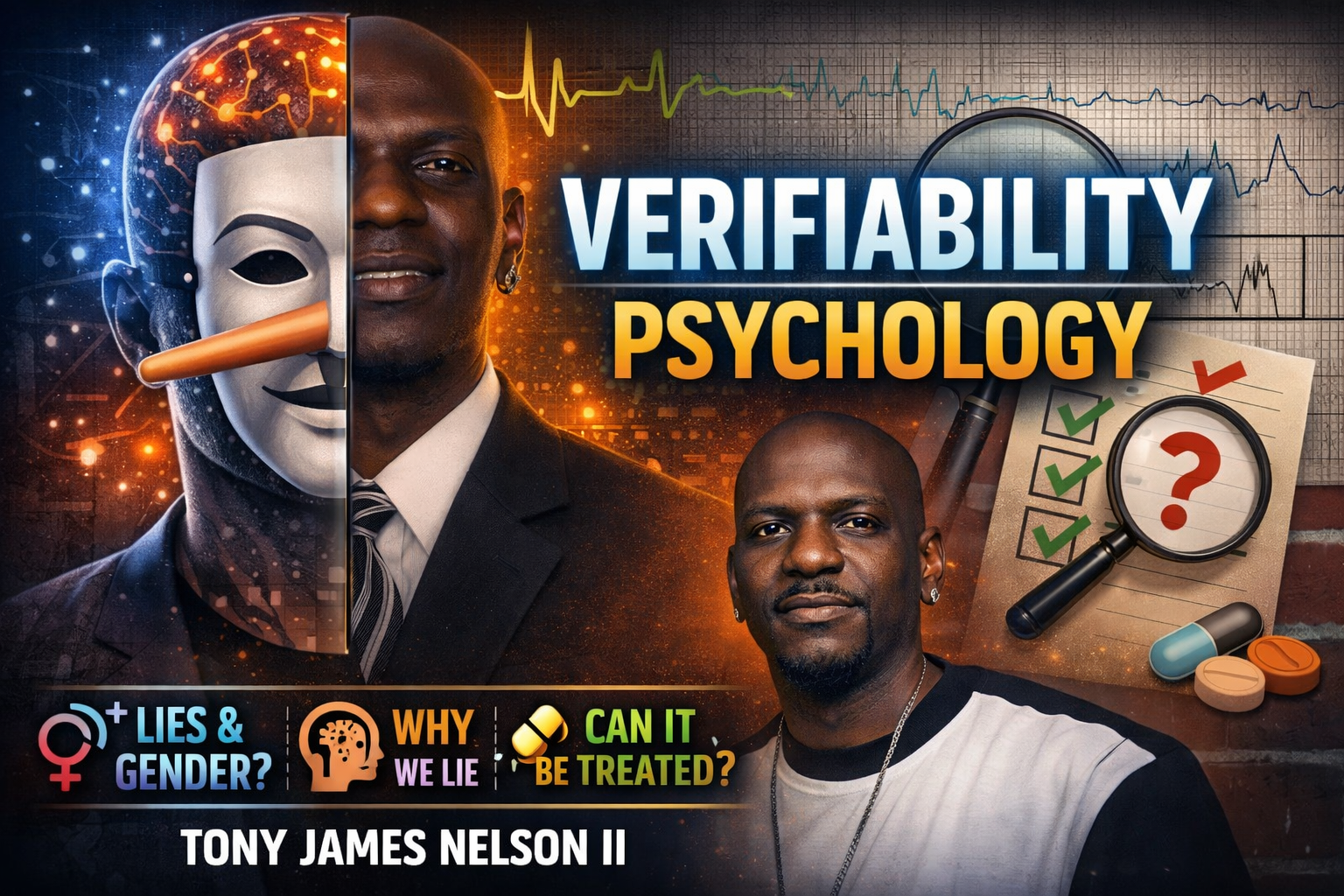
Most “lie detection” conversations (and a depressing number of “experts”) start in the same place: spot the liar. Watch the eyes. Listen for stutters. Count the fidgets. Trust your gut.
Verifiability Psychology starts somewhere radically less dramatic and a lot more useful:
Don’t hunt for “liar vibes.” Measure whether a claim can be verified.
Not who is lying — but how information becomes checkable, and what forces people toward truth, half-truth, or fog.
That shift sounds small. It isn’t. It’s the difference between:
-
“That person looks deceptive.” (high confidence, low evidence)
and “This story contains five verifiable anchors and two unverifiable gaps.” (low drama, high signal)
This article lays out the core ideas of Verifiability Psychology as a proposed new field, describes how Tony James Nelson II is positioning it as a research and applied framework, and tackles the big questions people actually care about:
-
Do men or women lie more?
-
Why do people lie at all?
-
Can chronic lying be treated with therapy or medication?
-
What does lying do to the brain and body — stress, arousal, long-term health?
-
How do we study deception without turning into witch-hunters?
1) Why we need a new field (because lie detection is… kinda bad at its job)
Humans are not reliably good at judging who is lying based on behavior alone. Large meta-analyses have found that people’s accuracy in detecting deception tends to hover only modestly above chance, and behavioral “cues” are often weak, inconsistent, or context-dependent.
That’s not because people are stupid. It’s because deception is strategic, and truth-telling can look “weird” under stress, trauma, neurodivergence, cultural mismatch, disability, or fear of authority. Meanwhile, practiced liars can look calm.
So Verifiability Psychology doesn’t begin with “Can I catch you?”
It begins with “Can this claim be checked?”
2) The core idea: truth is a pipeline, not a personality trait
Verifiability Psychology treats truth as a process — a pipeline:
Memory → Narrative → Communication → Documentation → Verification
At each stage, things can go wrong without anyone “lying”:
-
Memory can be distorted.
-
Narratives compress details under stress.
-
Communication adapts to the audience (sometimes badly).
-
Documentation can be missing or impossible to obtain.
-
Verification depends on systems and power.
This is why “liar vs honest person” is an oversimplification.
The better question is:
How much of this story could be independently verified if we tried?
That’s the heart of the field.
3) Tony James Nelson II’s “Verifiability Turn”
The way Tony James Nelson II frames this new field is basically a philosophical jailbreak:
Stop diagnosing deception as a trait and start measuring verifiability as a property of claims and contexts.
In this proposal, “Verifiability Psychology” isn’t just about catching lies — it’s about building better truth environments: in relationships, workplaces, medicine, law, journalism, and even AI systems.
A key move here is that the field is designed to be ethically safer than classic lie detection:
-
It discourages labeling people as liars from vibes.
-
It reduces bias risk by focusing on evidence structure.
-
It pushes for systems that make truth easier to document.
4) Do men or women lie more?
This question is popular because people want a clean scoreboard. Science rarely hands those out.
What the research suggests (in broad strokes)
A large meta-analysis of dishonesty experiments (565 studies; 44,050 participants) found a small overall gender difference, with men lying somewhat more than women in those experimental paradigms.
But “lying” isn’t one thing. Different studies look at different kinds of dishonesty:
-
lying for self-gain,
-
lying to help someone else,
-
lying that harms another person,
-
lying that benefits both parties.
A meta-analysis focused on sender–receiver game paradigms reported that men were more likely than women to tell certain categories of lies (including “black lies” that benefit the liar at a cost to someone else, and some prosocial categories depending on definitions).
The Verifiability Psychology interpretation
Instead of “men lie more” vs “women lie more,” the field asks:
-
Which contexts change the incentives?
-
Which lies are easier to verify?
-
Who experiences higher “evidence friction” (i.e., has less access to documentation, resources, or institutional trust)?
Because here’s a key ethical trap: if one group has less ability to produce proof, they may look “less credible” even when truthful. Verifiability Psychology treats that as a system problem to measure and fix.
5) Why people lie (the honest taxonomy of dishonesty)
People lie for reasons that range from mundane to pathological. Verifiability Psychology organizes motives by function, because function predicts what kind of evidence trail you’ll see.
A) Reward-seeking lies
-
Money, status, access, avoiding consequences.
-
Often show strategic vagueness or selective detail.
B) Conflict-avoidance lies
-
“I’m fine.” “Nothing’s wrong.”
-
Often create emotional ambiguity rather than factual contradiction.
C) Impression-management lies
-
Curating identity, saving face, avoiding shame.
D) Prosocial lies (“white lies”)
-
Protecting feelings, smoothing social interactions.
-
May be common, culturally shaped, and not always harmful.
E) Loyalty lies
-
Covering for in-group, protecting family/friends.
F) Compulsive/pathological patterns
-
Lying that becomes pervasive, identity-linked, or self-defeating.
This last category overlaps with what clinical literature describes as pseudologia fantastica (pathological lying / mythomania): persistent, elaborate fabrication, sometimes mixed with belief-like conviction, and often associated with broader psychiatric or personality dynamics.
6) The brain on lies: cognitive load, control networks, and “lie friction”
Lying is often mentally harder than telling the truth because you’re doing multiple tasks at once:
-
inhibit the truthful response,
-
construct an alternative,
-
monitor consistency,
-
manage the listener’s reactions.
Neuroimaging meta-analyses and reviews repeatedly implicate executive control networks — especially regions of the prefrontal cortex and anterior cingulate cortex — as involved in deception tasks.
A classic meta-analytic line of work suggests deception recruits mechanisms tied to working memory and executive control.
The important nuance
Not all lies are cognitively heavy:
-
rehearsed lies,
-
socially scripted lies,
-
lies of omission,
-
identity-protective lies
…can become “low friction,” which leads to a darker question:
Does lying get easier with practice?
Evidence suggests it can — at least in some contexts. A study in Nature Neuroscience reported that repeated dishonesty (especially self-serving) was associated with reduced brain response in the amygdala over time, and that reduced response predicted escalation in dishonesty.
Verifiability Psychology treats this as a risk trajectory:
small unverifiable distortions → reduced emotional resistance → larger distortions
7) What lying does to the body: stress, arousal, and possible health links
Lying can activate physiological arousal — the classic “fight-or-flight” system — particularly when stakes are high or the liar fears detection.
A review on the physiology of dishonesty discusses associations between dishonest behavior and physiological signatures (including arousal-related measures and endocrine responses), and raises the possibility that chronic dishonesty may have negative health implications over time.
There’s also research suggesting that reducing lying may be associated with improvements in self-reported health outcomes in some contexts (though this kind of work can involve many confounds).
Verifiability Psychology makes a careful claim here
Not “lying always wrecks your body.”
But:
-
deception can involve stress reactivity,
-
chronic stress load can harm health,
-
and some people live in a constant loop of concealment, hypervigilance, and self-monitoring.
So the field emphasizes measuring:
-
stake level
-
fear of consequence
-
duration of concealment
-
physiological load
instead of treating “lying” like one uniform toxin.
8) Can lying be treated? Therapy, medication, and what actually changes behavior
First: lying isn’t a diagnosis
Lying is a behavior. Treatment depends on why it’s happening.
When therapy helps most
Therapy is most promising when lying functions as a tool for:
-
fear regulation,
-
shame avoidance,
-
trauma coping,
-
attachment insecurity,
-
impulse control problems,
-
self-esteem scaffolding,
-
identity instability.
Clinical discussions of pathological lying (including pseudologia fantastica) emphasize the importance of differential diagnosis and a careful, rapport-based approach; the literature often notes the complexity and limited standardized evidence base.
Approaches that may be relevant depending on the person:
-
CBT (cognitive behavioral therapy): patterns, triggers, consequences
-
DBT (dialectical behavior therapy): emotion regulation, distress tolerance
-
Schema therapy: deep self-beliefs (“I’m only safe if…”)
-
Trauma-focused therapies when deception is protective coping
What about medication?
There is no “anti-lying medication.”
But medication may help if lying is driven by or embedded in treatable conditions (e.g., severe mood instability, impulsivity, psychosis-spectrum symptoms, substance use, etc.).
Evidence for meds specifically improving pathological lying is limited and often case-based, but there are case reports describing clinical improvement in some patients when underlying psychiatric factors were treated pharmacologically.
The Verifiability Psychology treatment lens
Instead of “stop lying,” the target becomes:
-
increase verifiable truth behaviors
-
reduce evidence avoidance
-
build safe accountability loops
-
treat the emotional engine behind concealment
9) The “Verifiability Toolkit”: how this field measures truth without becoming paranoid
Verifiability Psychology borrows inspiration from “verifiability” approaches used in investigative interviewing research, which emphasize whether details can be independently checked rather than relying on shaky behavioral tells. Replication and applied work in this area suggest verifiability-based methods can be promising in certain contexts.
But the new field expands the idea beyond interviews:
Key constructs the field would formalize
1) Verifiable anchors
Details that can be checked: timestamps, locations, transactions, third-party confirmations, records.
2) Evidence friction
How hard it is for a person to produce proof even when truthful (poverty, disability, lack of documentation, systemic distrust).
3) Claim structure
Does a statement contain:
-
checkable specifics,
-
plausible constraints,
-
internal consistency,
-
clear pathways to verification?
4) Accountability loops
Systems that reward truth-telling and reduce incentive to fabricate.
A simple, non-creepy interview move (example)
Instead of: “Are you lying?”
Ask: “What parts of this could someone else verify?”
That question does two things:
-
truth-tellers usually have some checkable anchors,
-
liars often drift toward vagueness or unverifiable detail (though not always).
And crucially: it avoids “gotcha theater.”
10) The big ethical rule: do not weaponize this
A field about verifiability can still be abused — especially by people who want power more than truth.
So a serious Verifiability Psychology framework needs hard ethics:
-
Never diagnose “liar” from physiology, body language, or vibes.
-
Separate “unverified” from “false.” (Unverified is not a conviction.)
-
Quantify uncertainty.
-
Audit bias and evidence friction.
-
Prefer interventions that increase verifiability over punishments that incentivize better lying.
11) A research agenda that could make this a real discipline (not just a cool idea)
If Tony James Nelson II wants this to land as a legitimate field, here’s what would turn it into a research program:
-
Define a Verifiability Index
A scoring system for claim checkability (with inter-rater reliability testing). -
Run experiments across contexts
-
low-stakes daily life lies vs high-stakes institutional lies
-
written vs spoken claims
-
memory distortion vs intentional deception
-
cultures and subcultures with different “truth norms”
-
Build a dataset (ethically)
Anonymized narratives with labeled verifiable anchors, plus ground truth where possible. -
Intervention studies
Test whether training people to produce verifiable anchors:
-
improves accuracy in disputes,
-
reduces conflict,
-
reduces false accusations,
-
improves health outcomes in chronic concealment situations.
-
Clinical translation
Develop therapy modules focused on:
-
evidence-avoidance,
-
shame regulation,
-
truth tolerance (the ability to tell hard truths without collapsing).
12) Closing thought: truth isn’t just moral — it’s ergonomic
One of the most interesting ideas behind Verifiability Psychology is that dishonesty can be cognitively and physiologically expensive — not always, but often enough that it matters. It recruits control networks in the brain, can provoke stress responses, and can become self-reinforcing through adaptation mechanisms.
So the goal isn’t to create a society of perfect honesty (that’s a horror movie).
The goal is to make truth easier to tell, easier to check, and harder to punish — so lying becomes less necessary, less rewarding, and less contagious.
If Verifiability Psychology becomes real, it won’t be because it “catches liars.”
It’ll be because it builds systems where reality has better customer service.