
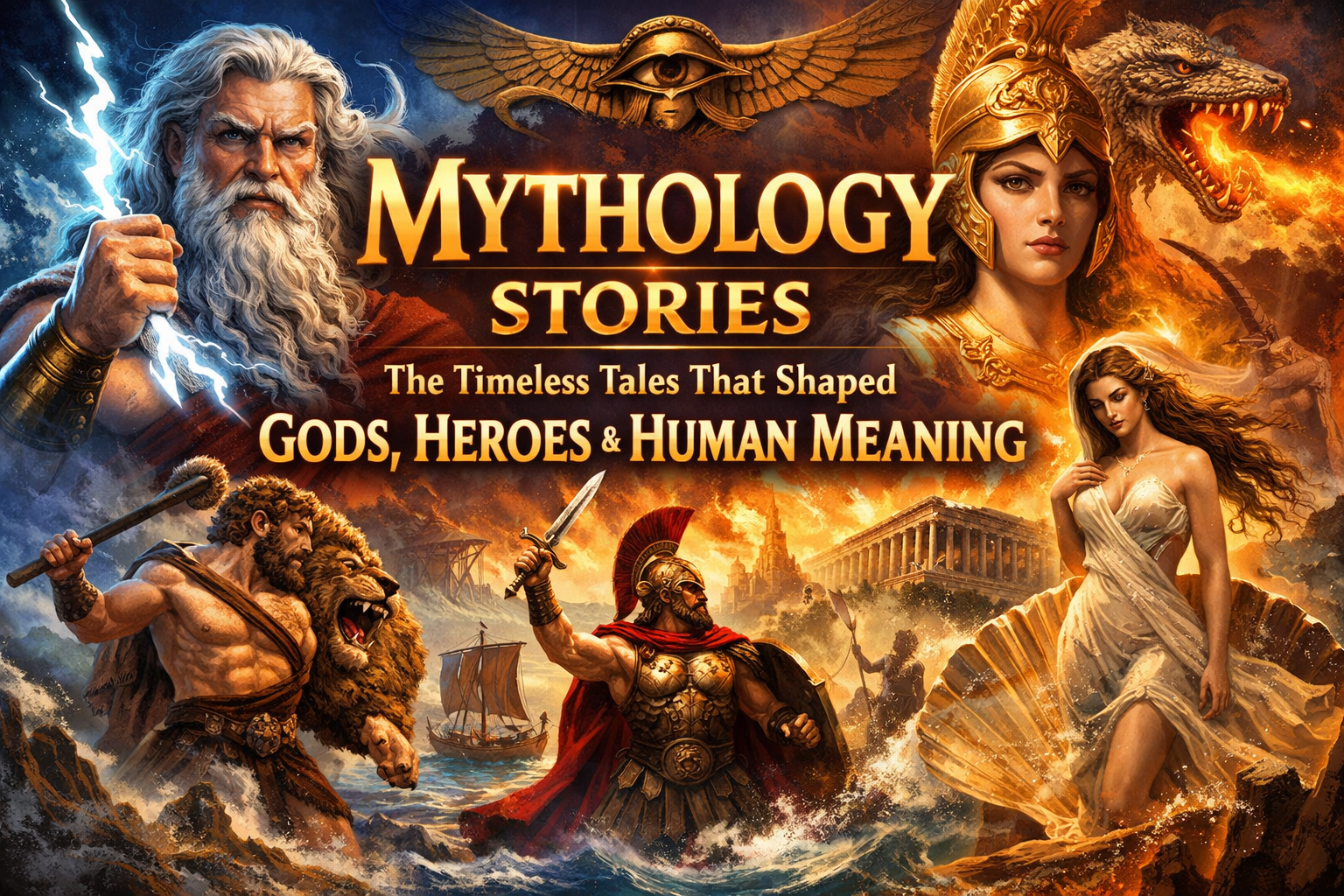
Mythology stories are humanity’s oldest blockbuster universe—except instead of movie studios and streaming services, these tales were forged by oral tradition, carved into stone, sung beside fires, and carried across continents in the minds of storytellers. Long before science explained lightning or psychology mapped the mind, mythology stories did the heavy lifting: they explained the world, taught social rules, dramatized fear and hope, and gave people a language for the mysteries of birth, death, love, power, and fate.
And here’s the wild part: even when we “stop believing” in myth, we keep living inside it. The DNA of mythology stories shows up in superhero narratives, fantasy epics, sports legends, celebrity culture, political rhetoric, and even the way we describe our own lives—my journey, my struggle, my redemption arc. Myths never really leave. They just change costumes.
In this deep dive, we’ll explore what mythology stories are, why they exist in every culture, the most famous myth traditions around the world, the archetypes that keep repeating, and how you can start reading myths in a way that feels alive—not like dusty homework.
What Are Mythology Stories?
Mythology stories are traditional narratives—often sacred or culturally foundational—that explain how the world works and why humans live the way they do. They typically involve gods, spirits, monsters, creation events, heroic quests, cosmic battles, and moral transformations.
Unlike modern fiction, mythology stories weren’t originally told as “just entertainment.” They were:
-
Explanations (Why do we have seasons? Why do we die? Why is the ocean salty?)
-
Identity maps (Who are we? Where did our people come from?)
-
Social instruction (What counts as justice? What is taboo? What happens when pride goes unchecked?)
-
Spiritual frameworks (How should we relate to forces greater than ourselves?)
A myth is not “a lie.” In everyday speech, people say “that’s a myth” to mean false. But in mythology studies, myth means something closer to meaningful story—a symbolic narrative a culture uses to interpret existence.
Why Mythology Stories Exist in Every Culture
You can drop a group of humans anywhere on Earth and, given enough time, you’ll get mythology stories. Not because people are gullible—but because humans are pattern-making machines with emotions, mortality, and imagination.
Here’s why myths arise so reliably:
1) We Fear Chaos, So We Build Narrative Order
Storms, disease, death, drought—ancient life was full of unpredictable danger. Mythology stories turn chaos into plot. They make terror understandable: the storm is a god angry, the plague is a spiritual imbalance, winter is the world grieving.
2) We Learn Through Stories Better Than Rules
“Don’t be arrogant” is a lecture.
“Watch Icarus fly too close to the sun and fall” is a myth.
Mythology stories are moral memory devices.
3) We Need Meaning in Suffering
Myths don’t just explain nature—they explain pain. Why do good people suffer? Why do promises break? Why does betrayal sting so badly? Myth gives suffering context, even when the answer is tragic.
4) Myths Bond Communities
Shared myths create shared identity: we are the people who came from that mountain, we honor that ancestor, we fear that trickster, we keep that ritual because once, the gods taught us how to survive.
Myth vs. Legend vs. Folktale: What’s the Difference?
These categories overlap, but a simple breakdown helps:
-
Mythology stories: Sacred or foundational narratives involving gods/cosmic forces and explaining reality.
-
Legends: Stories rooted in possible history (heroic kings, founders, wars) but embellished over time.
-
Folktales: Everyday community stories—often humorous or moral—usually not sacred (talking animals, clever peasants, wicked stepmothers).
Example:
-
Zeus vs. Titans = myth
-
King Arthur = legend
-
Jack and the Beanstalk = folktale
But cultures remix these categories constantly. That’s part of the fun.
The Big Themes in Mythology Stories
Myths are different across cultures, yet they rhyme. Certain themes appear like recurring “story molecules.”
Creation and the Origin of Everything
How did the world begin? Out of water? Darkness? A cosmic egg? A giant’s body? A divine word?
Creation myths are a culture’s first philosophy.
The Fall: Why the World Isn’t Perfect
Many mythologies include a “break” in the world’s order—Pandora opening the jar, humans disobeying sacred rules, a betrayal among gods. These stories explain why suffering exists.
Flood Myths and World Resets
From Mesopotamia to South Asia to the Americas, flood myths appear everywhere. Sometimes it’s punishment. Sometimes it’s renewal. Often it’s both.
The Hero’s Journey
A flawed person receives a call, faces trials, descends into danger, returns changed. This structure is so common it practically has its own passport.
Tricksters: The Sacred Chaos Agents
Tricksters (Loki, Anansi, Coyote, Hermes-like figures) break rules, steal fire, invent tools, mock authority, and accidentally teach wisdom. They’re comedy with sharp teeth.
Underworld and Afterlife Stories
Mythology stories often map death: underworld gates, judgment, reincarnation, ancestor realms, spirit roads. These myths are emotional technology for grief.
Mythology Stories From Around the World
Let’s tour major myth traditions—not as a checklist, but as living story worlds. Each has its own vibe, like different genres of the same cosmic library.
Greek Mythology Stories: Drama, Desire, and Fate
Greek mythology stories are intensely human. The gods aren’t perfect—they’re powerful, petty, romantic, jealous, and unpredictable. Fate is a force even gods respect (or fear).
Core Greek myth highlights:
-
Creation and Titans: Chaos → Gaia → Titans → Olympians
-
Zeus vs. the Titans: Power struggle as cosmic politics
-
Persephone and Hades: Explains seasons, marriage, and mortality
-
Odysseus: Intelligence vs. chaos, homecoming as spiritual survival
-
Prometheus: Stealing fire—technology, rebellion, and punishment
Greek myths ask: What happens when desire outruns wisdom? Often: tragedy.
Norse Mythology Stories: Doom, Honor, and Cosmic Winter
Norse mythology stories feel like epic poetry carved into ice and iron. The gods know the end is coming—Ragnarök—and still choose courage.
Key Norse myth beats:
-
Yggdrasil: The world tree holding realms together
-
Odin: Wisdom purchased through sacrifice
-
Thor: Protection, strength, and the everyday hero
-
Loki: Trickster who becomes catastrophe
-
Ragnarök: Not just apocalypse—renewal through destruction
Norse myth asks: What does it mean to be brave when you can’t win forever?
Egyptian Mythology Stories: Order, Resurrection, and Sacred Kingship
Egyptian mythology stories orbit Ma’at—cosmic order, balance, truth. The gods maintain stability against chaos, and death is a doorway, not an ending.
Highlights:
-
Osiris, Isis, Set, Horus: Murder, resurrection, justice, rightful rule
-
Ra’s solar journey: The sun’s daily battle against the serpent of chaos
-
Anubis and judgment: Heart weighed against truth
Egyptian myth asks: How do we keep the world from falling apart? Answer: balance, ritual, responsibility.
Hindu Mythology Stories: Cosmic Cycles and Divine Avatars
Hindu mythology stories are vast—more like an ocean than a library. Time is cyclical, reality has many layers, and the divine takes multiple forms.
Common myth currents:
-
Vishnu’s avatars (like Rama and Krishna): Divinity entering history to restore dharma (cosmic duty/order)
-
Shiva: Destruction as transformation, not nihilism
-
The Mahabharata and Ramayana: Epic moral complexity, devotion, duty, war, love, exile
These myths ask: How do we act rightly in an impossibly complex world? Answer: dharma, devotion, and self-knowledge.
Chinese Mythology Stories: Harmony, Immortals, and Cosmic Bureaucracy
Chinese mythology stories often explore harmony between heaven, earth, and human society. Immortals, dragons, and celestial politics appear alongside moral lessons.
Themes include:
-
The Jade Emperor and heavenly order
-
The Monkey King (Sun Wukong): Chaos, rebellion, enlightenment (a mythic antihero masterpiece)
-
Dragons as power, weather, and fortune rather than “evil monsters”
Chinese myths ask: How do we align with the way of the universe? Answer: balance, virtue, and transformation.
African Mythology Stories: Tricksters, Creation, and Community Wisdom
Africa holds thousands of myth traditions—richly diverse. Many focus on how humans gained fire, language, death, or social customs.
Famous threads:
-
Anansi (West Africa): the spider trickster—stories about cleverness, consequences, and culture itself
-
Creation myths involving sky gods, earth spirits, and sacred animals
-
Emphasis on community ethics and ancestral presence
These myths ask: How does wisdom travel through people? Answer: story, rhythm, and collective memory.
Indigenous Mythology Stories: Land, Spirit, and Relationship
Across Indigenous cultures worldwide, mythology stories often emphasize relationship—between humans, animals, land, sky, ancestors, and spirit beings. Nature isn’t scenery. It’s family.
Common elements:
-
Coyote / Raven trickster-transformers
-
Creation through animals, songs, dream journeys, or sacred geography
-
Moral focus on reciprocity: take only what you need, respect the world that feeds you
These myths ask: How do we live as part of the world, not above it?
The Most Common Archetypes in Mythology Stories
Even if you’ve never read a single myth, you already recognize these characters. They’re baked into modern storytelling.
-
The Hero: faces trials, returns transformed (Hercules, Gilgamesh, Rama)
-
The Mentor: offers wisdom/tools (Athena, Odin-like guides, ancestral spirits)
-
The Trickster: disrupts rules, reveals hypocrisy (Loki, Anansi, Coyote)
-
The Monster: externalized fear or chaos (Medusa, dragons, giants)
-
The Divine Mother: protection, creation, fierce love (Isis, Demeter)
-
The Underworld Lord: death as power and boundary (Hades, Hel)
-
The Shadow Twin: rival who mirrors the hero’s flaws (Set vs. Osiris/Horus dynamics)
Archetypes aren’t rigid boxes—they’re patterns. Mythology stories remix them endlessly.
Why Mythology Stories Still Matter Today
Modern life looks nothing like ancient life… and yet mythology stories remain weirdly accurate about the human condition.
Myths Are Psychology Before Psychology
Jealous gods, forbidden knowledge, hero ego, trickster sabotage—myths dramatize internal conflicts. Read them as emotional maps and they become startlingly modern.
Myths Teach “Consequences With Teeth”
Myths rarely say “be humble” politely. They show pride detonating lives. They show shortcuts backfiring. They show what happens when you ignore warnings—because humans are stubborn, and stories are persuasive.
Myths Are Cultural Memory
They preserve values, history, identity, and sacred meaning. Even when religions change, mythic patterns remain.
Myths Fuel Modern Creativity
Fantasy authors, comic writers, filmmakers, game designers—everyone borrows from mythology stories. Myth is the creative well that never runs dry.
How to Start Reading Mythology Stories Without Getting Overwhelmed
If you’re new to myths, don’t try to “learn everything.” Mythology is not a single subject—it’s a universe.
Start like this:
-
Choose a tradition that genuinely intrigues you (Greek? Norse? Egyptian? Hindu?)
-
Pick a few core stories (creation myth, underworld myth, a hero cycle)
-
Read retellings first, then primary sources later (older translations can be dense)
-
Track recurring characters like you would in a TV series
-
Ask what the myth is doing: explaining nature, teaching morals, reinforcing identity, exploring psychological conflict?
Myths aren’t puzzles with one answer. They’re mirrors that reflect different truths depending on where you stand.
Mythology Stories FAQ
Are mythology stories the same as religion?
Not exactly. Mythology stories often belong to religious traditions, but mythology also includes cultural narratives that may not be actively worshiped today. Some myths are sacred scripture in one context and literature in another.
Why do different cultures have similar myths?
Humans share common experiences: storms, death, birth, love, conflict, seasons. Similar problems generate similar story solutions. There’s also cultural exchange—trade routes and migration spread stories.
Which mythology is best to start with?
Greek mythology stories are often the easiest entry point because they’re widely retold and referenced. Norse is also beginner-friendly if you like darker, heroic tones.
Conclusion: Mythology Stories Are the Original Human Operating System
Mythology stories aren’t relics. They’re living structures in the human mind—tools for meaning-making, cultural identity, moral reflection, and imaginative power. When you read mythology stories, you’re not just reading about gods and monsters.
You’re reading about humanity attempting to understand itself with the best technology it had: story.
And maybe that’s why myths last. Our tools keep changing. Our questions don’t.